
LYFnGO Logo
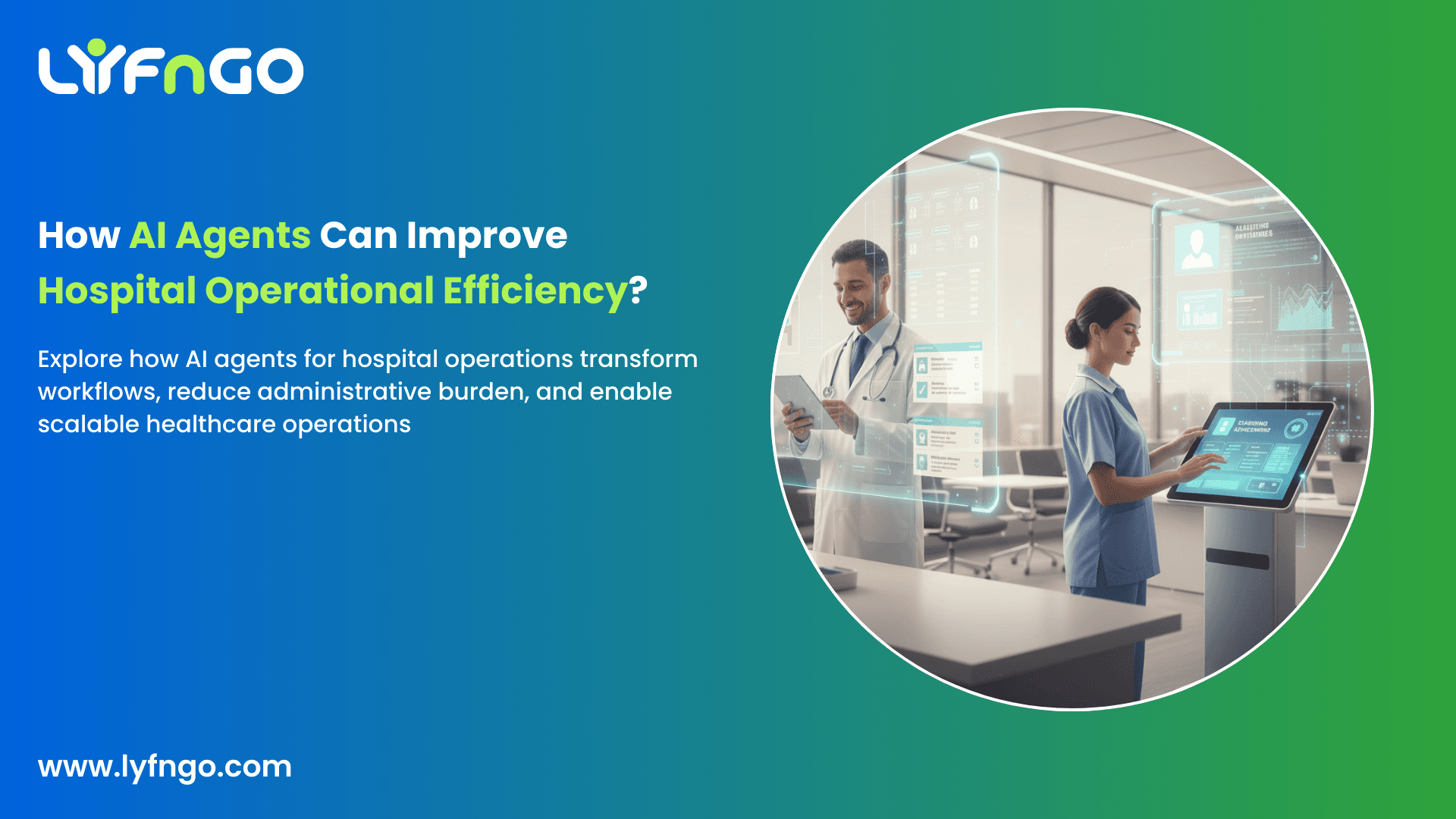
Blog Hero

How AI Agents Can Improve Hospital Operational Efficiency

December 30, 2025

Hospitals are places of healing—but behind every successful patient outcome is a complex web of operations working (or struggling) in the background.

From appointment scheduling and admissions to staff coordination, billing, and discharge planning, hospitals manage thousands of moving parts every single day. When even one process slows down, the ripple effect is felt everywhere—by doctors, nurses, administrators, and most importantly, patients.

In recent years, the pressure on hospitals has only intensified. Rising patient volumes, workforce shortages, increasing costs, regulatory demands, and growing expectations for faster, better care have made hospital operational efficiency a top priority.

Yet many hospitals still rely heavily on manual processes, disconnected systems, and reactive decision-making.

This is where AI agents in hospital operations are stepping in—not as futuristic concepts, but as practical, intelligent solutions that help hospitals run smarter, smoother, and more efficiently.

In this blog, we’ll explore how AI agents for hospital operations are transforming workflows, reducing administrative burden, and enabling true healthcare operations automation.

Table of Contents

  1. The Real Challenge Behind Hospital Operations
  2. What Are AI Agents in a Hospital Context?
  3. Why AI Agents Are Becoming Essential for Hospitals
  4. How AI Agents Improve Hospital Operational Efficiency
  5. Why Agentic AI Platforms Matter
  6. How LYFnGO Powers AI-Driven Hospital Operations
  7. Measurable Outcomes Hospitals Can Expect
  8. The Future of Hospital Operations Is Intelligent
  9. Final Thoughts

The Real Challenge Behind Hospital Operations

When people think of hospitals, they often picture doctors treating patients or nurses providing care. What they don’t see is the massive operational engine behind the scenes.

Every hospital must coordinate:
  • Patient appointments and admissions
  • Doctor and nurse schedules
  • Bed availability
  • Medical equipment and supplies
  • Billing, insurance, and claims
  • Compliance and documentation
  • Follow-ups and discharge planning
Most hospitals manage this complexity using a mix of legacy software, spreadsheets, emails, phone calls, and manual coordination. The result is delays, inefficiencies, errors, staff burnout, and frustrated patients.

Operational inefficiency doesn’t just affect costs - it directly impacts care quality. Long waiting times, rushed staff, delayed discharges, and administrative confusion all stem from operational gaps.

This is why hospitals are increasingly turning to AI agents in hospital operations - not to replace people, but to support them.

What Are AI Agents in a Hospital Context?

AI agents are intelligent, goal-driven digital systems that can observe, decide, and act independently or alongside humans. Unlike traditional automation, AI agents for healthcare operations understand context, adapt to changing conditions, and improve over time.

In hospitals, AI agents for hospital operations function like digital team members that:
  • Monitor workflows continuously
  • Automate repetitive and time-consuming tasks
  • Coordinate between departments and systems
  • Provide real-time insights and alerts
  • Learn from operational data to optimize outcomes
Instead of automating one task at a time, AI agents manage entire workflows—making them especially powerful for complex hospital environments.

Why AI Agents Are Becoming Essential for Hospitals

Several factors are driving the adoption of AI agents in hospital operations:

1. Increasing Operational Complexity

Hospitals now operate like large enterprises, where manual coordination cannot keep up with the scale and speed required.

2. Staff Burnout at an All-Time High

Doctors, nurses, and administrators spend excessive time on paperwork and coordination. AI agents significantly reduce this burden.

3. Underutilized Operational Data

Hospitals generate massive volumes of data, but without intelligence, much of it remains siloed and unused.

4. Financial Sustainability Depends on Efficiency

Operational inefficiencies lead to revenue leakage, wasted resources, and rising costs.

AI agents for hospital operations directly address these challenges by enabling connected, proactive, and efficient workflows.

How AI Agents Improve Hospital Operational Efficiency

Let’s explore where AI agents in hospital operations make the most meaningful impact.

1. Smarter Patient Intake and Admissions

Patient intake is often the first point of friction. Manual forms, repeated data entry, insurance delays, and long queues slow down operations.

AI agents improve intake by:
  • Enabling digital pre-registration
  • Automated insurance verification
  • Flagging missing or inconsistent data
  • Reduced front-desk workload
This leads to faster admissions, fewer errors, and smoother patient experiences.

2. Intelligent Appointment Scheduling

Hospital scheduling involves doctors, rooms, equipment, urgency, and patient availability.

AI agents for hospital operations enable:
  • Automated scheduling using real-time availability
  • No-show prediction and reduction
  • Real-time reallocation of cancelled slots
  • Balanced departmental workloads
This improves patient flow and resource utilization.

3. Optimizing Patient Flow and Bed Management

Poor patient flow is a major barrier to hospital operational efficiency.

AI agents help by:
  • Tracking Real-time bed occupancy tracking
  • Discharge timeline prediction
  • Coordinated admissions, transfers, and discharges
  • Early alerts for bottlenecks
This dramatically improves throughput, especially during peak demand.

4. Reducing Administrative Burden for Staff

Administrative work is one of the biggest contributors to burnout in clinic management.

AI agents assist by:
  • Automated documentation workflows
  • Standardized templates and forms
  • Auto-filled records using structured data
  • Compliance checks without manual effort
This allows clinicians to spend more time with patients.

5. Workforce and Shift Optimization

Staffing inefficiencies impact both care quality and costs.

AI agents support:
  • Predicting staffing needs based on patient volume
  • Automated shift scheduling
  • Balanced workloads
  • Reducing unnecessary overtime
This ensures optimal staffing without guesswork.

6. Streamlining Billing and Revenue Cycle Management

Revenue leakage often results from manual billing processes.

AI agents enable healthcare operations automation by:
  • Validating billing data
  • Tracking claim status automatically
  • Identifying denial patterns
  • Reduced manual follow-ups
Hospitals benefit from faster reimbursements and improved cash flow.

7. Intelligent Inventory and Supply Chain Management

AI agents:
  • Monitor real-time inventory usage
  • Predict demand based on trends
  • Automated reordering
  • Reduced waste and expiries
This lowers costs and prevents shortages.

8. Real-Time Operational Insights for Leadership

Traditional reports are delayed and static.

AI agents provide:
  • Continuous operational monitoring
  • Real-time risk alerts
  • Actionable cross-department insights
This shifts hospital management from reactive to proactive.

Why Agentic AI Platforms Matter

While individual AI tools provide value, their true potential is unlocked when they work together. This is where agentic AI platforms come in.

An Agentic AI platform:
  • Connect all operational systems
  • Enable AI agents to collaborate
  • Learn continuously from outcomes
  • Scale across departments and locations
This unified approach is essential for modern hospitals.

How LYFnGO Powers AI-Driven Hospital Operations

LYFnGO is an integrated agentic AI platform designed to optimize hospital operations at scale.

With LYFnGO, hospitals can:
  • Manage operations from a unified dashboard
  • Deploy AI agents for hospital operations across intake, scheduling, staffing, billing, and follow-ups
  • Integrate seamlessly with existing systems
  • Gain real-time visibility into operational efficiency
By embedding AI agents in hospital operations, LYFnGO improves efficiency without disrupting care delivery.

Measurable Outcomes Hospitals Can Expect

Hospitals adopting AI agents for healthcare operations typically see:
  • Reduced patient wait times
  • Higher staff productivity
  • Better resource utilization
  • Faster billing cycles
  • Lower administrative costs
  • Improved patient satisfaction
These gains compound over time.

The Future of Hospital Operations Is Intelligent

Hospitals are complex operational ecosystems. AI agents enable smarter coordination, reduced friction, and stronger support for healthcare professionals—aligning efficiency with compassion.

AI agents in hospital operations enable smarter coordination, reduced friction, and better support for healthcare professionals.

The future of AI in hospital operations is about empowering people, improving care, and building hospitals that function as efficiently as they heal.

Conclusion

Improving hospital operational efficiency is no longer optional—it is essential for delivering timely, high-quality, and sustainable healthcare.

Through intelligent automation and connected workflows, AI agents for hospital operations reduce friction, improve coordination, and support healthcare teams where it matters most.

With healthcare operations automation powered by platforms like LYFnGO, hospitals can move beyond fragmented systems toward a future that is intelligent, efficient, and deeply human.

Want to see how this works in real hospital environments?

Book a demo session to explore LYFnGO’s AI agents in action and see how they seamlessly integrate with your existing systems to optimize hospital operations end to end. You can also start a 7-day free trial to experience the impact firsthand - before making any commitment.

Related Blogs

The Impact of Chatbots and Virtual Assistants in Healthcare: Transforming the Future of Patient Care

The Impact of Chatbots and Virtual Assistants in Healthcare: Transforming the Future of Patient Care

August 14,2025

How AI Agents Are Revolutionizing Patient Engagement in Hospitals?

How AI Agents Are Revolutionizing Patient Engagement in Hospitals?

December 24, 2025

Improving Clinic Workflows: Best Practices for Better Care with an Integrated Agentic AI Platform

Improving Clinic Workflows: Best Practices for Better Care with an Integrated Agentic AI Platform

December 30, 2025

whatsapp iconwhatsapp hover